Deal snapshot
Proprio, Inc. is a Seattle company that spun out of the University of Washington in 2016 . Co-founders include CEO Gabriel Jones and CMO Dr. Samuel Browd . It raised a $23M Series A in 2020 (DCVC) and a $43M Series B in July 2023 . Revenue is undisclosed . The FDA lists four Paradigm 510(k) clearances, April 2023 to December 2025 . Google Patents lists two granted US patents, from March and May 2025 .
Thesis
This has a lot of potential: low radiation and a quick workflow, especially for short and mid-length constructs, perhaps longer fusions . An optical view is more flexible than a rigid CT and could show vertebrae moving as the spine is pulled into shape . Registration time could drop to near zero .
What Paradigm does
Paradigm builds a 3D model from the pre-op CT. Once the anatomy is exposed, cameras match the live bone's topography to that model . Because surgery is open, the system registers on visible bone, which I think is smart . The indication is open posterior pedicle screw placement, thoracic to sacrum . From company videos, I read that no patient-mounted reference is needed .
Where navigation fails
O-arm navigation works extremely well in my experience, including long S2 alar-iliac screws and the cervical spine . The big risk is loss of registration, above all when missed . A bumped reference marker is a common cause . I saw the dangerous version in the past: in a multilevel cervical fusion every screw ended up about half a millimetre to the right, half in the canal and half in the foramina, cause unknown . A system that re-registers continuously and flags drift would matter more to me than going radiation-free .
The radiation argument
In a regular spondylodesis the confirmatory scan stays: it is another layer of security and medico-legal documentation . Proprio claims Paradigm eliminates intraoperative scans and saves up to 30 minutes per procedure .
Accuracy and safety record
To our knowledge no independent peer-reviewed accuracy study of Paradigm exists . The FDA summary lists cadaveric design validation . The surgeon who did the first-in-human case in October 2023 says almost all other navigation needs some intraoperative radiation; he is an early user, not an independent evaluator . To our knowledge openFDA lists no adverse event or recall for Paradigm .
Competitive context
Paradigm's first clearance names Envision 3D (K162375) as predicate, a device cleared to 7D Surgical . Both use cameras to register exposed bone to the pre-op CT without a scan, so they belong to the same technology class . SeaSpine agreed in 2021 to buy 7D for $110M , and Orthofix's 7D FLASH claims registration as low as 30 seconds . To our knowledge no public data shows which system is more accurate . The patents protect different things: 7D's grants claim surface-to-surface registration per spinal level , Proprio's 12,299,907 claims the sensor-array hardware . More competitors do not change the technology, but Proprio is judged in this context . Unique, hard-to-copy, well-patented technology would count in its favour .
Business model stress test
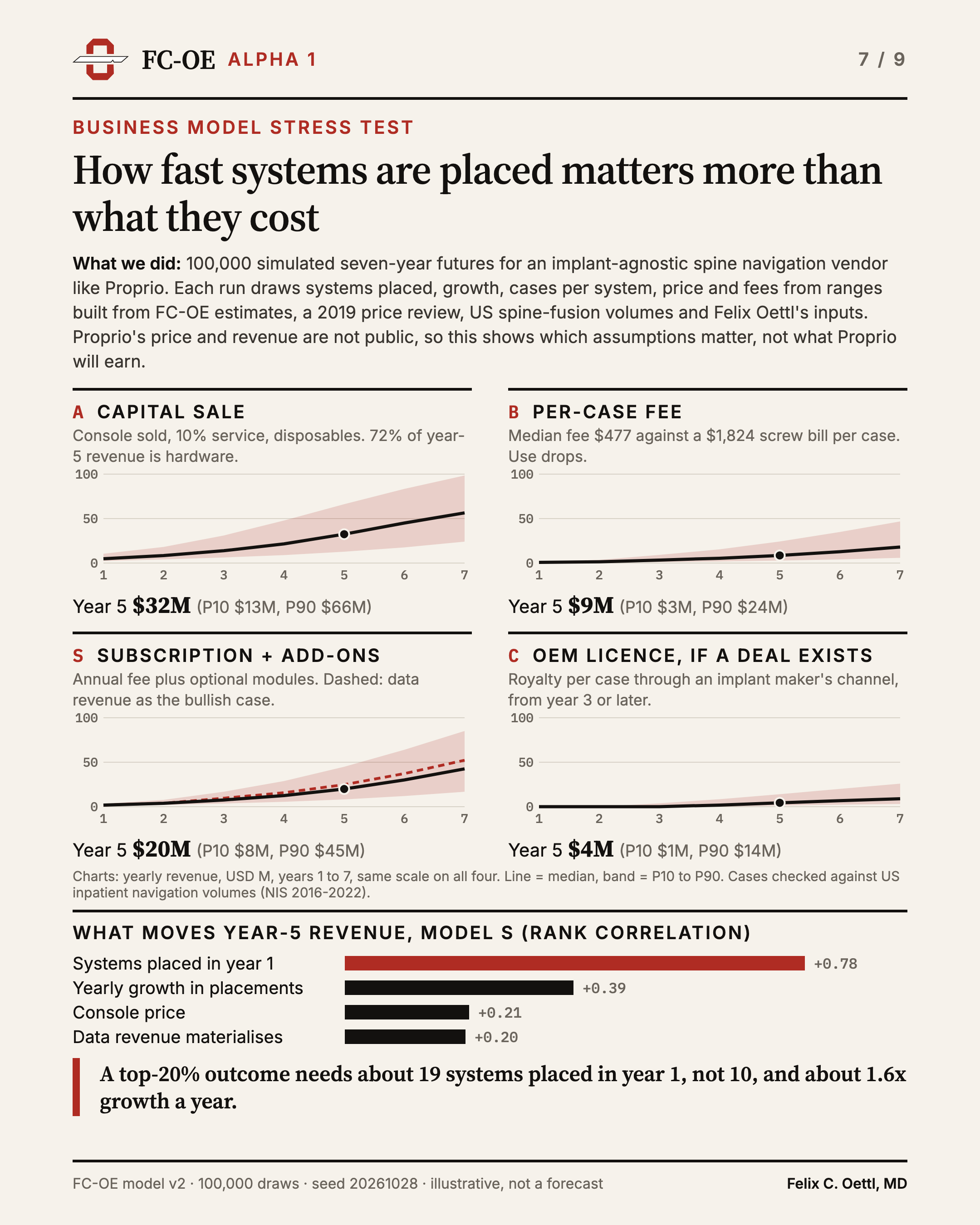
How will it make money? We simulated 100,000 seven-year futures for an implant-agnostic navigation vendor like Proprio. Price and revenue are not public, so inputs are FC-OE estimates and Felix's: a fancy screw costs $185 to $350 . In the simulation, median year-5 revenue is $32M for capital sale, $20M for subscription with add-ons and $9M for a per-case fee . A per-case fee would reduce use, so subscription with add-ons fits better . How fast systems are placed matters more than price . Data is the large upside, in revenue and as exit . This is illustrative, not a forecast.
What would make me wrong
A clinical study showing screws off target, much more bone exposure needed for registration, or failure in obese patients . KOLs say it cannot be percutaneous; for multilevel fusion you never go percutaneous anyway, so this only limits indications .
Verdict
Scores, 1 worst to 10 best: workflow 9; regulatory 10 (cleared is cleared); machine learning 7 (interesting, unclear how much they do) .
In five years very few pedicle screws will go in without navigation. That is about navigation in general, and a system like Proprio's might accelerate it . Integration decides the winner . I expect a buy-out eventually by a large company such as Stryker, Medacta or J&J, less likely Smith+Nephew .
My stance: watch for now. I would engage if it is in spine or if they expand to other regions, and back them if the technology proves superior and hard to copy, and if it integrates with a partner .
Questions for the founders:
- How will you make money? Navigation is often razor-and-blade: the system is almost free and the money is in the screws. What do you charge?
- What does Paradigm do that 7D FLASH does not, and what is your proof, by bone exposure and body habitus? (proposed by Claude)
- Does Paradigm detect and flag registration drift? (proposed by Claude)