
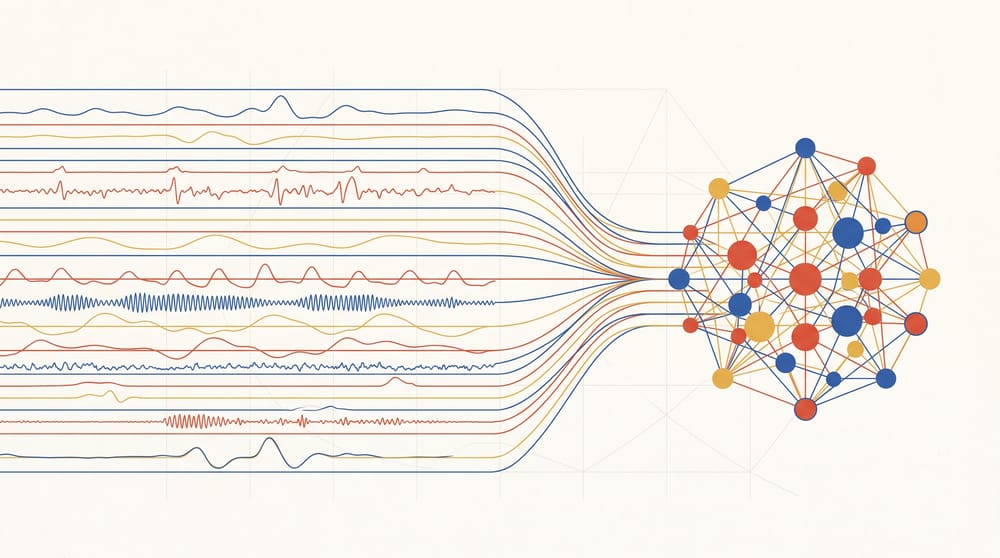
SensorFM_ a wearable foundation model pretrained on over one trillion minutes of sensor data from five million participants, evaluated across 35 discriminative health tasks and — critically — validated as an inference tool for exactly the kind of Personal Health Agent Google has now commercialized. The consumer launch and its evidence base arrived the same week, in that order.
The headline scientific result is genuinely strong. In a blinded evaluation yielding 1,860 clinician ratings, health-summary responses grounded in SensorFM's predictions were rated statistically indistinguishable from responses grounded in actual clinical ground-truth labels, and both beat the no-prediction baseline across all five rubric dimensions, including harm. Model-derived inferences carried the same downstream utility as verified diagnoses when handed to an LLM coach — a defensible technical basis for the product's core claim that wearable-grounded AI guidance is meaningfully better than an LLM reasoning over raw metrics alone.
The gap the product marketing elides is the one the paper is candid about. SensorFM's authors frame its outputs as screening, risk stratification, and longitudinal tracking — explicitly not a replacement for clinical diagnosis. The agent evaluation was single-turn, blinded to condition, and built on a cohort skewed toward female, White, and higher-BMI Fitbit adopters that does not mirror the US population; there is no EHR-verified outcome validation, and several agent inferences (mental health, sleep) had no ground truth to test against at all. The shipped product inherits these limits behind a "general wellness" disclaimer — not intended for medical purposes, check responses for accuracy — which is simultaneously the regulatory shield that lets Google scale without SaMD clearance and the ceiling on what the coach can defensibly assert.
That ceiling is under pressure from Google's own roadmap. The Google Health app now ingests medical records, lab results, and medications for US users, and the enterprise arm (formerly Fitbit Enterprise, with health-system bridges to Mayo Clinic and Kaiser Permanente) is positioning the same stack as a population-health instrument for payers and employers. As the data surface becomes progressively clinical and the distribution channel becomes institutional, the distance between "not for medical purposes" and de facto clinical influence narrows — and the accuracy and hallucination concerns already flagged in early Fitbit Air reviews become the material risk vector. For procurement and investment audiences, SensorFM is the strongest published evidence yet that consumer wearable inference has crossed into clinically useful territory; the open question is whether the wellness framing survives contact with the clinical data the product is now designed to consume.
Pre-Print Intelligence (arXiv)
Harrison.Rad 1.5 Technical Report: A radiology foundation model that can draft reports from images, priors and clinical context
Brief: Harrison.Rad 1.5 is a multimodal foundation model designed to automate radiology reporting by integrating X-ray images, prior studies, and clinical context into structured drafts. It utilizes a three-stage training pipeline involving domain adaptation, contrastive vision-encoder training on 6 million instances, and VQA fine-tuning to achieve FRCR-level diagnostic accuracy across multiple anatomical regions. The system employs advanced explainability metrics like Grad-CAM and ontology-based evaluation to validate clinical alignment.
Methodological Integrity: The reliance on a simulated FRCR examination and internal datasets for primary validation introduces potential bias regarding real-world workflow integration and generalizability to diverse, unstructured hospital data. While the 6-million-instance training set is substantial, the absence of prospective, multi-center clinical trials limits the assessment of performance under actual clinical entropy and data noise.
Strategic Implication: This technology directly addresses radiologist workforce shortages by reducing reporting time, positioning it as a high-value efficiency tool for radiology departments. However, its commercial success depends on seamless integration into existing EHR workflows and overcoming regulatory hurdles for autonomous report generation without human-in-the-loop verification.
Executive Summary: Harrison.Rad 1.5 demonstrates state-of-the-art performance in generating radiology reports from multimodal inputs, meeting simulated board certification standards. The model represents a significant technical advancement in automating diagnostic documentation but requires rigorous prospective validation before widespread clinical deployment.
Innovation: 8/10 | Applicability: 7/10 | Commercial Viability: 8/10
ECGLight: Compute-Light Framework For Paper ECG Digitization and Myocardial Infarction Screening
Brief: ECGLight is a compute-light, on-device framework that digitizes paper ECGs via smartphone capture and screens for Myocardial Infarction using lightweight models, achieving 95.51% accuracy on PTB-XL and 88.89% on a hospital-acquired dataset. The system operates in under 30 seconds on CPU-only hardware, targeting remote clinics lacking connectivity or high-end compute infrastructure. It integrates SHAP for interpretability, aiming to democratize access to AI-driven cardiac diagnostics in resource-constrained settings.
Methodological Integrity: Validation relies heavily on public datasets (PTB-XL) and a single hospital-acquired dataset, raising concerns about generalizability to diverse paper ECG formats, varying print qualities, and real-world noise without external multi-center clinical trials. The study lacks prospective validation in actual remote clinical workflows, leaving potential biases from image capture conditions and dataset-specific artifacts unaddressed.
Strategic Implication: This technology addresses a critical gap in global cardiac care by enabling AI diagnostics in low-resource environments, potentially reducing missed acute coronary occlusions and delaying reperfusion therapy. However, its impact is constrained by the need for widespread smartphone adoption in target regions and integration into fragmented, non-digital healthcare systems.
Executive Summary: ECGLight offers a practical, low-compute solution for converting paper ECGs into actionable digital diagnostics, demonstrating high accuracy in controlled evaluations. Its success hinges on overcoming real-world deployment challenges, including variable image quality, regulatory approval, and adoption in underserved healthcare ecosystems.
Innovation: 8/10 | Applicability: 7/10 | Commercial Viability: 7/10
Solve the Missing First Step: Can VLMs Standardize Raw Heterogeneous Medical Data?
Brief: MDS-Bench is a 1,939-task benchmark (100 datasets; classification, segmentation, detection) that evaluates whether agentic VLMs can perform the upstream step existing medical benchmarks skip — converting raw, heterogeneous clinical folders (DICOM, NIfTI, TIFF, masks, metadata) into standardized, source-grounded image-JSON pairs. Under an eleven-metric protocol, the best model (Gemini 3 Flash) reaches only 48.6% end-to-end success, with schema validity high (80.0–88.2%) but content and joint metrics far lower.
Methodological Integrity: Benchmark-only, constructed from public imaging datasets that the authors concede may not reflect private PACS/EHR environments, access controls, or incomplete real-world metadata; ground truth relies on model-assisted extraction with human verification, leaving residual annotation error, and detection (6 datasets) plus several 3-dataset modality groups are underpowered and explicitly descriptive.
Strategic Implication: Directly relevant to procurement diligence — it quantifies that "diagnostic AI" performance on curated inputs materially overstates real-world readiness, and that the unglamorous ingestion/standardization layer, not the diagnostic model, is where deployment breaks; buyers should test vendors on raw-data handling rather than clean-input demos.
Executive Summary: The first benchmark isolating raw medical data standardization as a distinct task shows frontier VLMs fail more than half of end-to-end cases, evidencing that the data-ingestion bottleneck for clinical AI remains unsolved.
Innovation: 8/10 | Applicability: 5/10 | Commercial Viability: 4/10
PubMed Gems
Health system learning enables generalist neuroimaging models.
Brief: NeuroVFM is a visual foundation model trained on 5.24 million uncurated clinical MRI and CT volumes to overcome the scarcity of public neuroimaging data. By utilizing a 'health system learning' paradigm, it achieves state-of-the-art performance in radiologic diagnosis and report generation while significantly reducing hallucinations compared to frontier models. The system embeds scans into a shared latent space to ground diagnostic findings, enabling safer clinical decision support when paired with language models.
Methodological Integrity: The reliance on uncurated, real-world clinical data introduces risks regarding label noise and potential demographic bias inherent in routine care records. Validation against expert preference and triage accuracy is promising, but the absence of a detailed breakdown on how privacy-preserving techniques were applied to the 5.24 million patient volumes requires scrutiny for regulatory compliance.
Strategic Implication: This approach directly addresses the bottleneck of data entropy in radiology by leveraging existing health system infrastructure rather than requiring pristine academic datasets. It positions the technology as a scalable foundation for generalist neuroimaging AI, potentially displacing specialized, siloed diagnostic tools with a unified, high-accuracy system.
Executive Summary: NeuroVFM demonstrates that training on massive, uncurated clinical datasets yields superior generalist neuroimaging models compared to those trained on limited public data. The model effectively reduces diagnostic errors and hallucinations, establishing a viable framework for deploying foundation models in routine clinical workflows.
Innovation: 9/10 | Applicability: 8/10 | Commercial Viability: 9/10
AI-driven diagnostic algorithm enhances early detection of paroxysmal nocturnal hemoglobinuria in real-world settings.
Brief: Saventic Health's SARAH platform screened 1,307,140 patients across 14 Polish hospitals using structured and unstructured (BERT-based NLP) EHR data, flagging 356 high-risk PNH cases; of 119 referred for flow cytometry, 13 were confirmed (PPV 10.92%, 95% CI 9.68–12.30%) versus a 6.9% conventional screening hit rate. The flagged cohort skewed older (median 69.5y) and atypical — only 2.25% presented with haemoglobinuria versus 45–62% in registries — with retrospectively identified diagnostic delays of 74–1,337 days.
Methodological Integrity: Severe conflict of interest — AstraZeneca (a complement-inhibitor manufacturer with direct commercial interest in expanding the treated PNH population) funded the study, and authors are employees/shareholders of AstraZeneca and Saventic; only 33.4% of flagged patients underwent confirmatory testing (verification bias), sensitivity/specificity are estimates vulnerable to undetected cases in the non-flagged arm, the algorithm is proprietary and non-reproducible, and the single-country hospital-based design limits generalizability. Published in npj Digital Medicine.
Strategic Implication: Exemplifies the pharma-funded "diagnosis-as-case-finding" model for orphan drugs — modest incremental yield (10.92% vs 6.9%) but genuine identification of guideline-missed older presentations; real-world barriers were administrative (loss to follow-up, paper records, referral discretion) rather than algorithmic, and no outcome data (mortality, thrombosis) link earlier detection to benefit.
Executive Summary: The first prospective multi-centre real-world deployment of an AI PNH screening tool improves the diagnostic hit rate over conventional screening, but sponsor/developer conflicts, 67% untested flagged patients, and absence of outcome evidence constrain the strength of the efficacy claim.
Innovation: 7/10 | Applicability: 6/10 | Commercial Viability: 7/10
Prediction of incident atrial fibrillation from retinal fundus images using a multimodal foundation model.
Brief: RetiAF is a RETFound-based (ViT-large) retinal biomarker for incident AF prediction; the image-only score reached AUROCs of 0.8019 (UKBB internal test) and 0.7803 (external Shanghai cohort), and the Hybrid_RetiAF variant adding clinical features reached 0.8381 and 0.8694, outperforming CHARGE-AF (0.7553) and C2HEST (0.7246). Score-CAM and SHAP localized signal to the optic nerve head and vascular arcades, with a secondary exploratory CIHD association.
Methodological Integrity: Retrospective and observational with AF ascertained via ICD-10 coding and no prospective validation; development/testing cohorts were split by MRI-data availability (an unusual selection criterion), external validation used a single diabetes-screening Chinese cohort with only 472 AF cases, and some subgroup metrics are implausibly high (C2HEST≥3 AUROC 0.9936; RetiAF_Score OR 86.6), warranting scrutiny for optimism. Non-White subgroups are small; two authors hold editorial roles at the publishing journal, npj Digital Medicine (recused from review).
Strategic Implication: Fits the oculomics "one image, many diseases" thesis and could ride existing diabetic-retinopathy screening and fundus-camera infrastructure, but the clinical action pathway is unresolved — a positive RetiAF screen does not itself confirm AF or justify anticoagulation — and device heterogeneity plus SaMD regulatory clearance remain gating.
Executive Summary: A peer-reviewed retinal foundation-model biomarker predicts incident AF above conventional clinical risk scores across UK and Chinese cohorts with reasonable image-quality robustness, but retrospective design, ICD-based labels, and an unclear downstream care pathway limit near-term deployment.
Innovation: 7/10 | Applicability: 7/10 | Commercial Viability: 7/10
AI Clinical Trials (ClinicalTrials.gov)
throMboembolic Risk Associated To High atrIal Fibrillation riSk
Brief: The MATHIAS project proposes an AI-driven risk stratification model for thromboembolic events in pre-atrial fibrillation patients, leveraging high-dimensional EHR data to outperform the CHA2DS2-VASc score. It aims to integrate this tool into a prospective, digitally enabled care pathway involving photoplethysmography screening and personalized anticoagulation decisions. Preliminary retrospective data suggests near-perfect discrimination (AUC 99.99%), though prospective validation is pending.
Methodological Integrity: The reported Adaboost AUC of 99.99% against a baseline of 81.71% raises significant concerns regarding potential data leakage, overfitting, or lack of external validation in the retrospective phase. The transition from a single-cohort retrospective analysis to a multicenter prospective trial is critical to confirm generalizability and rule out spurious correlations in the training data.
Strategic Implication: Successful validation could shift the standard of care from reactive stroke management to proactive anticoagulation in the 'pre-AF' stage, capturing significant economic value by preventing high-cost disability events. However, clinical adoption hinges on overcoming the inertia of current guidelines and demonstrating that the AI's complexity yields actionable outcomes superior to existing opportunistic screening methods.
Executive Summary: MATHIAS targets a high-value gap in cardiovascular prevention by deploying AI to identify thromboembolic risk before overt atrial fibrillation diagnosis. While preliminary metrics are exceptionally high, the project's success depends entirely on rigorous prospective validation to prove clinical utility and cost-effectiveness in real-world primary care settings.
Innovation: 7/10 | Applicability: 7/10 | Commercial Viability: 8/10