
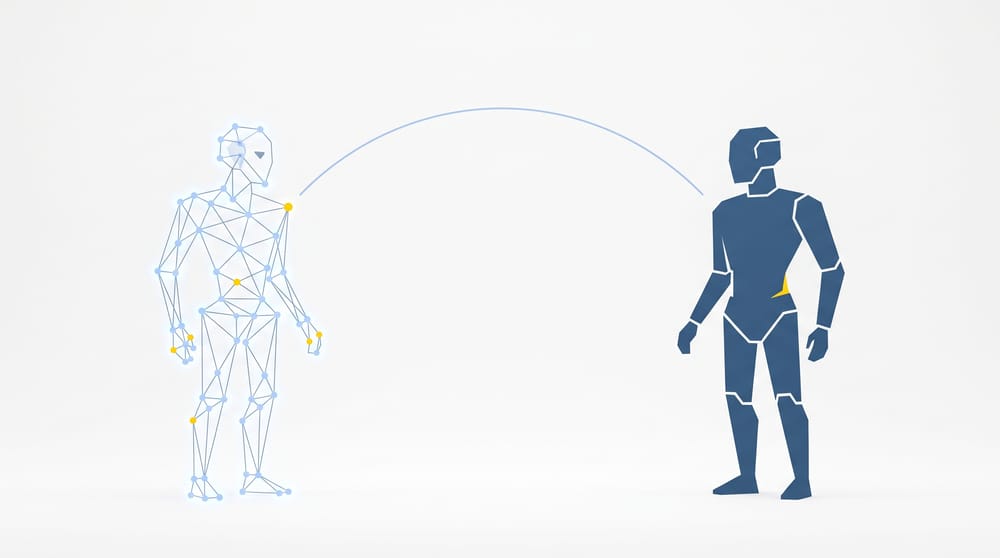
On July 30, DeepMind shipped Gemini Robotics ER 2, a standalone "embodied reasoning" model that acts as a high-level planner for robots — parsing continuous video, orchestrating multi-step tasks, and handing off motor execution to a separate vision-language-action (VLA) model or robotics API. The architectural bet is decoupling: reasoning and planning live in one model that any hardware platform can call, while execution stays with whatever VLA or control stack a given robot already runs. DeepMind demoed this pairing ER 2 with Boston Dynamics' Spot and Apptronik's Apollo 2, and it's now generally available via the Gemini API and Google AI Studio, with enterprise access in private preview.
The performance claims are specific enough to be checkable: 57.4% accuracy on five-bucket task-progress classification, 91.3% accuracy (0.96s mean absolute error) on "moment-finding" — identifying the exact frame a step completes — and gains on two new safety benchmarks (Human Proximity, Safety Instruction Following) where the model halts a humanoid when a person enters its workspace and resumes only once clear. Caveat: these are DeepMind's own benchmark suite against unnamed "competing frontier models," not third-party-replicated, and the safety technical report has not been independently audited. Treat the numbers as directionally credible, not clinical-grade validated.
For this audience, the proximity-halt behavior is the headline, not the video-progress-tracking. It's the first prerequisite for any robot operating in a patient-facing space — OR logistics, med/supply delivery, ambient monitoring — and a public reasoning layer lowers the barrier for health-robotics startups to build on top of it rather than engineering bespoke planning stacks. But the demo surface is industrial/domestic (Spot fetching a snack), not clinical, and DeepMind discloses no hospital pilots, no FDA/CE engagement, and no path from "halts near a person in a warehouse" to certifiable safety in an OR or ICU. Read this as an upstream platform signal for procurement teams tracking physical AI vendors — not as evidence anything ships into a hospital soon.
Pre-Print Intelligence (arXiv)
GuideSkill: Evolving Executable LLM Agent Skills for Guideline-Grounded Clinical Reasoning
Brief: GuideSkill creates executable functions from clinical practice guidelines that return ordinal diagnostic-support scores, initialized from guidelines (GuideSkill-Zero) and refined via case-diagnosis pairs (GuideSkill-Evo). At inference, an LLM proposes differential diagnoses, grounds required features, and fuses LLM rankings with skill outputs, improving accuracy across multiple backbones and benchmarks.
Methodological Integrity: Evaluation relies on four existing benchmarks and four LLM backbones, raising concerns about limited disease coverage and potential overfitting to the case-diagnosis pairs used for skill evolution. No external prospective validation or assessment of bias in guideline sources is reported, and skill coverage metrics may be inflated by training on the same data used for testing.
Strategic Implication: If integrated into clinical workflows, GuideSkill could enhance guideline adherence and reduce diagnostic variability, offering a model-agnostic safety layer for decision support. However, real-world impact depends on clinician trust, EHR interoperability, and regulatory clearance for software-as-a-medical-device.
Executive Summary: GuideSkill improves diagnostic accuracy by converting guideline text into executable scoring functions that are refined with case data, without updating the underlying LLM. The approach yields consistent gains across multiple model architectures and benchmarks.
Innovation: 9/10 | Applicability: 8/10 | Commercial Viability: 7/10
MedARC: Training-Free Adaptive Redundancy Compression of Visual Tokens for 3D Medical Vision-Language Models
Brief: MedARC introduces a training-free method to compress visual tokens in 3D medical vision-language models by scoring token importance using self-attention, text‑visual similarity, and deviation from a volume‑level feature center. The saliency‑aware merging strategy retains informative tokens while consolidating redundant ones, reducing sequence length without discarding potentially clinically relevant information. Experiments on CT‑RATE and MR‑RATE demonstrate lower inference time and maintained or improved diagnostic accuracy.
Methodological Integrity: The evaluation relies on two public datasets (CT‑RATE and MR‑RATE) and does not include external validation across diverse scanners, pathologies, or patient populations, limiting generalizability. As a training‑free approach, there is no risk of overfitting, but the importance cues may be biased by the underlying VLM’s pretraining data and may not adapt well to out‑of‑distribution volumes.
Strategic Implication: By cutting token overhead, MedARC can enable real‑time 3D VLM inference on modest hardware, lowering operational costs for hospitals and expanding the feasibility of deploying VLMs in radiology and orthopedic workflows. This efficiency gain could accelerate adoption of AI‑assisted diagnosis in resource‑constrained settings.
Executive Summary: MedARC provides a training‑free, multi‑cue token compression technique for 3D medical VLMs that reduces computational load while preserving diagnostic performance. Its effectiveness is demonstrated on CT‑RATE and MR‑RATE datasets.
Innovation: 7/10 | Applicability: 9/10 | Commercial Viability: 8/10
A report-grounded vision-language foundation model for colonoscopy from 280000 routine reports
Brief: EndoCLIP is a vision-language foundation model for colonoscopy that learns from 125,756 lesion-level image-text pairs extracted from 280,476 routine reports. It demonstrates strong zero-shot and linear-probe performance on lesion retrieval, report generation, and multi-centre classification tasks, with benign‑vs‑malignant linear probe accuracy approaching that of expert endoscopists.
Methodological Integrity: The study relies on weakly supervised pairs derived from free-text reports, which may introduce label noise and limit precise localization. Validation is primarily based on classification benchmarks and a blinded expert study; prospective clinical trials and real‑world workflow integration have not been demonstrated.
Strategic Implication: If deployed, EndoCLIP could reduce the need for task‑specific annotation by enabling clinicians to query findings in natural language, potentially streamlining polyp detection and report generation. However, regulatory clearance and seamless integration into existing endoscopy systems remain significant hurdles for widespread adoption.
Executive Summary: EndoCLIP leverages routine colonoscopy reports to create a vision‑language model that matches expert performance on key classification tasks. Its training approach turns unstructured documentation into scalable supervision for clinical AI.
Innovation: 8/10 | Applicability: 8/10 | Commercial Viability: 7/10
Re-thinking Mammography Transfer Learning: The Dataset-Informed Transfer Learning (DITL) Framework for Breast Cancer Screening and Lesion Diagnosis
Brief: DITL introduces adaptive difficulty-weighted cross-entropy and adaptive neighborhood representation triplet loss to improve mammography classification without manual hyperparameter tuning. The method uses k-nearest neighbor label purity in a self-supervised feature space to weight samples and learns margins for intra-class compactness and inter-class separation. Experiments on VinDR-Mammo and small ROI datasets show consistent gains in accuracy, F1, and AUC.
Methodological Integrity: Validation relies primarily on a single large-scale dataset (VinDR-Mammo) and limited small ROI sets, with no external multi-center testing reported. The self-supervised feature space and k-NN weighting may introduce label leakage if the same data inform both weight computation and training, and the paper lacks ablation studies isolating each component's contribution.
Strategic Implication: If validated across diverse populations and integrated into commercial mammography AI pipelines, DITL could reduce false-positive/negative rates in breast density and lesion classification, supporting radiologists and potentially lowering recall rates. However, clinical adoption would require prospective trials and regulatory clearance, which are not yet demonstrated.
Executive Summary: The DITL framework proposes adaptive loss functions for mammography classification that eliminate manual hyperparameter tuning. It reports state-of-the-art results on VinDR-Mammo and improved performance on small lesion datasets.
Innovation: 7/10 | Applicability: 8/10 | Commercial Viability: 7/10
OPERA: Offline Policy-guided Expert Routing and Adaptation for Universal Biomedical Image Analysis
Brief: OPERA introduces a multi-agent framework that learns an offline routing policy from a small validation set to assign biomedical images to expert models without updating those experts. At test time, it adapts via confidence calibration, distribution-aware class weighting, and instance-level routing based on model agreement and entropy. The method is evaluated across nine diverse biomedical imaging datasets, showing improved accuracy and calibration over 30+ baselines.
Methodological Integrity: The approach relies on a limited validation set for policy learning, which may not capture the full spectrum of real-world distribution shifts, raising concerns about overfitting to that subset. No explicit mention of external test‑set leakage, but the lack of detailed ablation on validation set size and potential bias in expert selection warrants caution.
Strategic Implication: If deployed, OPERA could reduce the need for costly per‑site fine‑tuning of imaging AI models, offering a plug‑and‑play solution for hospitals handling heterogeneous scanner protocols. However, the requirement to maintain and run multiple specialist models may limit adoption in resource‑constrained settings.
Executive Summary: OPERA presents an offline policy‑guided expert routing and adaptation technique for universal biomedical image analysis. It demonstrates consistent performance gains across multiple modalities and tasks without retraining expert agents.
Innovation: 8/10 | Applicability: 7/10 | Commercial Viability: 7/10
PubMed Gems
Nationwide federated learning for histopathology: secure deployment across Germany behind firewalls.
Brief: TheODen is a federated learning framework that enables histopathology model training across hospital firewalls without requiring port openings, using a reverse proxy to relay encrypted model updates. It was deployed across three German university hospitals, achieving dice scores of 0.764 on breast cancer and 0.754 on colorectal cancer segmentation, comparable to centralized training.
Methodological Integrity: The evaluation relies on a limited number of sites (three hospitals) and relatively small histopathology datasets, which may not capture broader population variability. No explicit privacy‑preserving aggregation (e.g., secure multiparty computation) is used, leaving potential model‑inversion risks unaddressed.
Strategic Implication: By lowering the deployment barrier for multi‑institutional AI projects, TheODen could accelerate the development of more robust pathology models, though its direct impact on clinical workflows remains indirect until those models are integrated into diagnostic tools.
Executive Summary: TheODen demonstrates feasible, firewall‑friendly federated learning for histopathology segmentation across a nationwide German hospital network. Performance matches centralized baselines while keeping raw data local.
Innovation: 7/10 | Applicability: 7/10 | Commercial Viability: 6/10
AI Clinical Trials (ClinicalTrials.gov)
Observational Study That Will Analyse the Spread and Stratification of Lung Cancer Risk Using Artificial Intelligence
Brief: The study evaluates the Sybil AI tool's ability to stratify lung cancer risk by comparing its outputs to LungRADS scores from radiologists and correlating AI-predicted STAS with histopathological findings. It uses an observational design to assess agreement and predictive performance across imaging and AI modalities.
Methodological Integrity: As an observational study, it risks confounding and selection bias without prospective randomization or blinded validation. Sample size and external generalizability are unclear, and potential data leakage between training and test sets is not addressed.
Strategic Implication: If validated, the tool could assist radiologists in nodule risk assessment, but its impact remains limited to a single-reader workflow without ambient or multiplayer coordination. Widespread adoption would require integration into existing PACS/RIS systems and demonstration of workflow efficiency gains.
Executive Summary: The study compares an existing AI risk stratification tool with standard radiologist classifications for lung nodules. It aims to establish concordance and histopathological correlation through observational analysis.
Innovation: 5/10 | Applicability: 8/10 | Commercial Viability: 8/10