
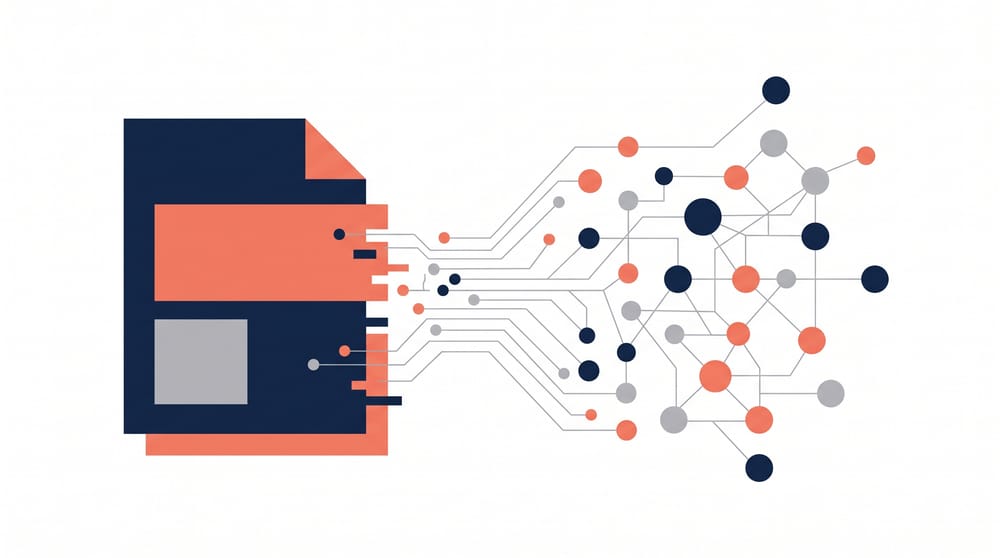
A Stanford preprint that made the rounds in AI-for-science circles a year ago just cleared peer review at Nature. That gap is worth sitting with: Paper2Agent was interesting enough as a preprint in September 2025 to get written up across the AI-research press before a single reviewer had signed off on it. It now has that sign-off, published online September 16, 2026, with no material change to the core claim: a paper's methods section and codebase can be automatically converted into a validated, queryable AI agent — one that answers questions, reruns analyses on new data, and talks to other paper-agents, without anyone touching the original repository by hand.
The mechanism is the part that should interest anyone who has ever tried to reproduce a computational method from a supplementary PDF. Paper2Agent's pipeline locates the codebase, builds an isolated environment, and converts tutorial workflows into discrete tools — but only the tools that pass automated validation against the paper's own reference outputs (numerical results within 3% tolerance, figures matched by perceptual hashing) survive into the final agent. Applied to AlphaGenome, the framework produced 22 working tools in 45 minutes for $14, and the resulting agent hit 98.7–100% accuracy on benchmark queries against ground truth, versus 37–57% for a general-purpose agent (Biomni) working from the raw repository. At scale, across 100 bioRxiv computational biology papers sampled without any curation for quality, 74 were successfully converted, yielding 593 validated tools and 91.2% accuracy on 300 benchmark questions — beating Claude Code with direct repository access (80.3–86.3%) at roughly half the cost and a quarter of the latency.
What this means for the "share your code" mandate: Journals and funders have spent a decade asking authors to post code and data; a recent analysis of AI-for-health publications found 74% still rely on private data or withhold code entirely, and even shared repositories routinely fail to reproduce on the first attempt. Posting a repository was never the same as anyone actually re-running it. Paper2Agent's validation loop is, in effect, a forcing function: a tool only ships if it reproduces the paper's own numbers, which quietly converts "code available" from a checkbox into a claim that gets tested every time someone builds the agent. This is exactly the friction the ESSKA AI & Innovation Committee keeps running into with orthopedic AI submissions — a reported Dice score or AUC in a manuscript, and no efficient way to confirm it runs on anything but the authors' own machine.
The paper is upfront about where this breaks down. A quarter of the 100 sampled bioRxiv papers couldn't be agentified at all — missing dependencies, absent data artefacts, unresolvable environments — and those are structural gaps no amount of agent orchestration papers over. The open-ended, researcher-style queries (the ones closest to how an analyst would actually use this) topped out at 82.7% accuracy, graded by two human raters rather than an objective ground truth. And the flagship discovery result — the agent reprioritizing GPR137 over the original paper's CELSR2/PSRC1 at a GWAS locus — is presented as evidence of the framework's value, but it equally shows that "causal gene" calls at complex loci remain genuinely contested; multiple nearby genes carried near-identical top scores, and the agent's pick still required an independent experimental cross-check to adjudicate. No competing interests are declared, and funding runs through NIH, the Chan-Zuckerberg Biohub, and Stanford — a clean disclosure profile for an academic methods paper.
The distinction worth holding onto for board-level evaluation of any "reproducible AI" claim: Paper2Agent automates internal reproducibility — does the code, run against its own paper's numbers, still produce its own paper's numbers. It says nothing about external validity — whether the method holds up on a population, a scanner, or a surgical cohort it has never seen. A model that ships as a perfectly validated Paper2Agent tool can still fail the moment it meets a hospital's own data. For a field where the harder question has always been generalization rather than mere execution, this is a genuine improvement to the plumbing — not a substitute for the multicenter validation work that still has to happen after the agent runs cleanly.
Pre-Print Intelligence (arXiv)
Bridging Modalities on the Cortex: Surface-based MRI to PET Translation with a Diffusion Bridge
Brief: The paper proposes DB-SUiT, a surface-based diffusion bridge that translates cortical MRI to FDG-PET using a spherical U-shaped Transformer to preserve cortical topology. The method outperforms volumetric baselines and improves dementia classification accuracy, approaching real PET performance. It generalizes to unseen dementia subtypes without retraining.
Methodological Integrity: Evaluation relies on two datasets and a blinded reader study, but potential bias may arise from limited demographic diversity and dependence on accurate cortical surface extraction, which could fail in low-quality scans. No explicit mention of external validation beyond one external cohort, raising concerns about overfitting to specific scanner protocols.
Strategic Implication: If validated at scale, the technique could reduce reliance on costly, radioactive PET scans, expanding access to dementia biomarkers in routine MRI workflows. However, clinical adoption would require regulatory clearance and integration into existing PACS/RIS systems, which may slow uptake.
Executive Summary: DB-SUiT achieves high-fidelity MRI-to-PET synthesis on the cortical surface, improving dementia diagnostic performance over MRI alone. The method demonstrates cross-cohort generalization without retraining.
Innovation: 9/10 | Applicability: 7/10 | Commercial Viability: 8/10
SONAR: A Structure-Consistent Neural Operator for Null-Space-Aware Sparse View CT Reconstruction
Brief: SONAR introduces a structure-consistent neural operator that learns a low-dimensional null-space-aware representation from sparse CT projections, separating measurement and pseudo-measurement residuals and lifting them via physics operators to constrain structural effects. An anisotropic U-shaped neural operator handles angular and detector dimensions, enabling cross-discretization reconstruction. Experiments on AAPM and clinical MARS photon-counting CT show PSNR gains of 1.87–7.63 dB over prior methods across varied view counts and resolutions.
Methodological Integrity: Validation relies primarily on simulated AAPM data and a single clinical MARS dataset, with limited external heterogeneity and no prospective clinical trial evidence. Potential risks include overfitting to specific scanner geometries and insufficient assessment of bias across patient demographics or pathology types.
Strategic Implication: By improving image quality at ultra-low view counts, SONAR could facilitate dose‑reduced CT protocols for musculoskeletal imaging, lowering radiation exposure and potentially increasing scanner throughput. Commercial adoption would hinge on integration with CT vendor reconstruction pipelines and successful navigation of FDA clearance for AI‑based image reconstruction.
Executive Summary: SONAR is a physics‑informed neural operator framework for sparse‑view CT reconstruction that achieves consistent PSNR improvements on benchmark and clinical data. It demonstrates robustness to changes in view number, image resolution, and discretization.
Innovation: 9/10 | Applicability: 8/10 | Commercial Viability: 7/10
Multi-Stage NeRF for Efficient 3D Coronary Artery Reconstruction from Two Narrow-Angle Angiographic Projections
Brief: The paper introduces NeCA++, a two-stage neural radiance field framework that reconstructs detailed 3D coronary artery models from only two narrow‑angle X‑ray angiographic projections. By first estimating a coarse vascular support (active region) and then refining it with vessel‑specific regularizations, the method mitigates gradient dilution and ambiguity inherent in sparse views. Experiments on public and synthetic datasets show superior accuracy and reconstruction times under 60 seconds per case.
Methodological Integrity: Validation relies on three datasets, one of which is synthetic, limiting generalizability to heterogeneous clinical populations and varying acquisition protocols. No prospective clinical trial or external multicenter validation is reported, raising concerns about overfitting and real‑world performance.
Strategic Implication: If validated clinically, the technology could reduce the need for additional angiographic runs, lowering radiation exposure and contrast use during cardiac catheterization. Adoption would require integration with existing cath‑lab imaging systems and regulatory clearance, representing a moderate‑to‑high barrier but a clear value proposition for interventional cardiology workflows.
Executive Summary: NeCA++ demonstrates that a multi‑stage NeRF approach can achieve high‑fidelity 3D coronary reconstruction from minimal angiographic input, with sub‑minute processing times. The work remains at the algorithmic validation stage, lacking the clinical and regulatory evidence needed for commercial deployment.
Innovation: 8/10 | Applicability: 7/10 | Commercial Viability: 7/10
Toward Complete Hospital Discharge Summarization with Abstract Meaning Representation
Brief: The paper proposes an evidence-driven discharge summarization framework that uses Abstract Meaning Representation (AMR) to align summary sentences with source text spans, providing explicit provenance links to reduce hallucinations. It evaluates the approach on MIMIC-III and a local UIC Health corpus, releasing code and trained models.
Methodological Integrity: The study relies on two corpora, one of which is a single-institution dataset, limiting generalizability and raising concerns about external validity. AMR parsing errors and potential leakage from overlapping training/test splits are not thoroughly addressed.
Strategic Implication: While the method improves traceability and may reduce hallucination-related risks, it still requires clinician review of generated summaries and evidence links, thus not fulfilling the ambient, proactive AI ideal outlined in the manifesto. Its impact is likely confined to incremental documentation efficiency rather than transformative workflow redesign.
Executive Summary: The work introduces a provenance-aware summarization technique using semantic graphs to mitigate LLM hallucinations in discharge notes. It demonstrates feasibility on two datasets but lacks broad validation and ambient operation characteristics.
Innovation: 7/10 | Applicability: 7/10 | Commercial Viability: 6/10
Democratizing Clinical Tumor Whole Genome Sequencing: 18-hour End-to-end Analysis via Trillion-parameter Large Language Models Locally Deployed on Consumer-grade Hardware
Brief: The paper demonstrates that a trillion-parameter biomedical large language model can be run on a consumer-grade RTX 4060 laptop to perform tumor whole-genome sequencing analysis from raw FASTQ to clinical report in 18 hours, achieving 99.62% F1 for somatic variant detection. This is accomplished via adaptive heterogeneous memory scheduling and model optimization that introduces minimal error relative to an industrial A100 cluster baseline.
Methodological Integrity: Validation relies on concordance with an existing high-performance pipeline rather than prospective clinical outcomes, raising concerns about generalizability across diverse tumor types and real-world noisy data. No details are provided on cohort size, demographic representation, or potential biases introduced by the model optimization steps.
Strategic Implication: If the claimed performance holds in varied settings, the approach could lower barriers to genomic oncology in resource-constrained clinics, though it does not directly address the multimodal, ambient, or multiplayer workflow priorities emphasized in the MSK/VLM-focused investment thesis.
Executive Summary: The study reports successful local deployment of a massive language model for rapid tumor WGS analysis on low-cost hardware. Accuracy metrics match those of established GPU-cluster pipelines under controlled conditions.
Innovation: 8/10 | Applicability: 5/10 | Commercial Viability: 6/10
AI Clinical Trials (ClinicalTrials.gov)
Effectiveness of Chat-based Mobile Application for Consultation (Zalo) in Improving Compliance With Follow-up Tests After Abnormal Chest X-ray Findings Interpret by Artificial Intelligent
Brief: The study is a randomized controlled trial assessing whether a chat-based mobile consultation via Zalo, combined with AI-interpreted chest X-ray results, improves patient compliance with recommended follow‑up tests for lung disease. Participants in the intervention group receive educational messaging and can ask doctors questions with guaranteed response times, while controls receive only brief advice. Follow‑up calls at one or six months measure test completion.
Methodological Integrity: Compliance is ascertained by self‑report during phone calls, introducing potential recall and social desirability bias; blinding of participants is impossible, and the verification of actual test completion relies on participant affirmation rather than objective records. The trial’s reliance on Zalo assumes universal access and consistent use, which may not hold across all demographic subgroups.
Strategic Implication: If proven effective, the approach offers a low‑cost, scalable strategy to boost adherence in settings where popular messaging apps dominate and AI‑assisted imaging is deployed, though its impact is limited to improving communication rather than redefining the diagnostic or care pathway. It does not address broader system‑level coordination or preventive health monetization.
Executive Summary: This RCT at Nhan Dan Gia Dinh Hospital evaluates whether adding Zalo‑based doctor consultation to AI‑interpreted chest X‑ray results increases follow‑up test completion compared to standard brief advice. The primary outcome is the proportion of patients who complete recommended imaging or specialist visits after abnormal screening.
Innovation: 4/10 | Applicability: 8/10 | Commercial Viability: 6/10